

How do fasting and feeding influence muscle protein turnover, and what’s the influence of intermittent fasting on muscle health?
Intermittent fasting (IF) has become a go-to strategy for reducing body mass and improving metabolic health. Approaches like alternate-day fasting (ADF), the 5:2 diet, and time-restricted eating (TRE) often lead to spontaneous caloric restriction and meaningful fat loss (Patikorn et al., 2021; Tinsley & LaBounty, 2015).
But while fasting is good for caloric control, skeletal muscle depends on two things that fasting removes:
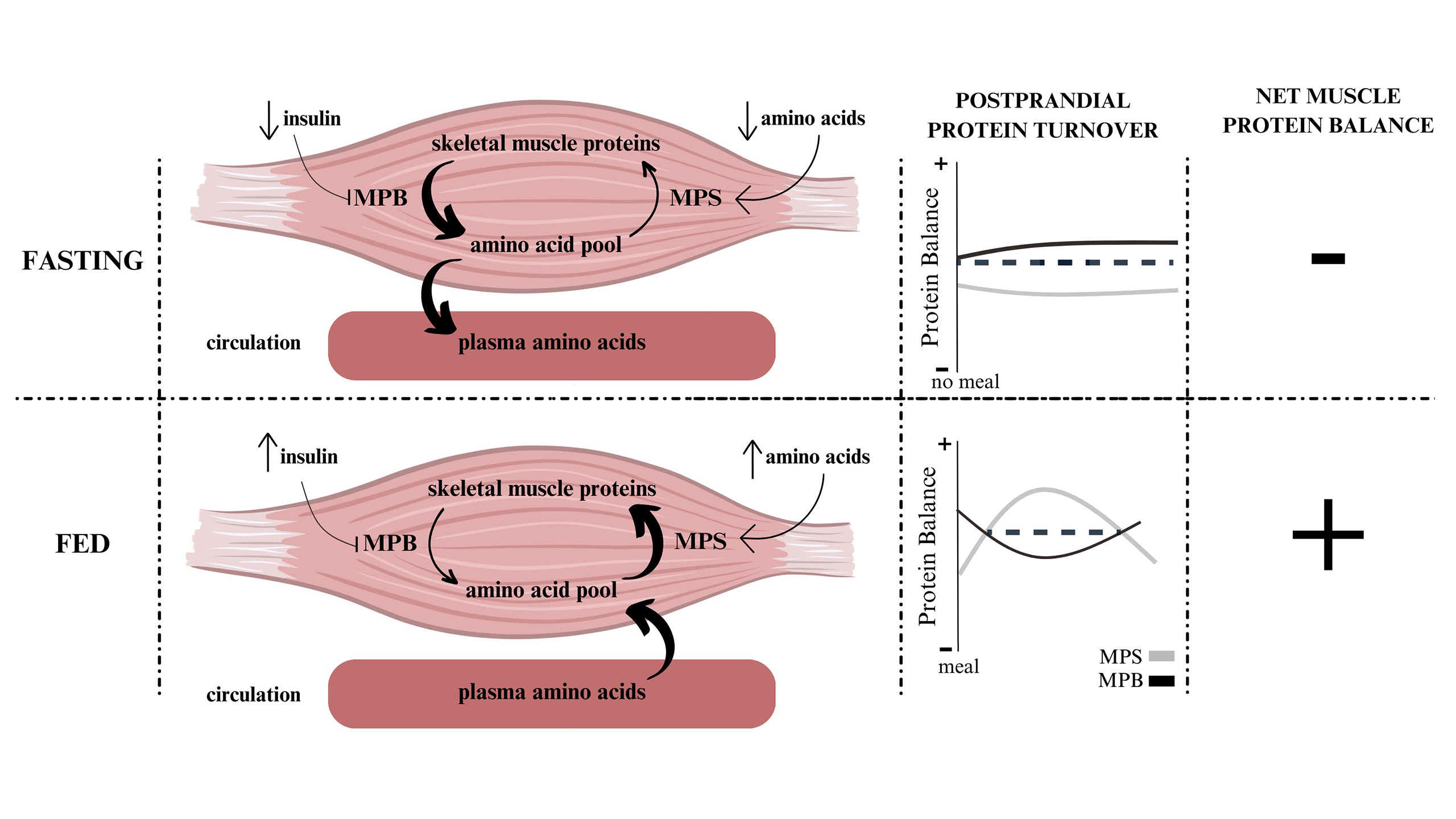
- Insulin – suppresses muscle protein breakdown (MPB)
- Dietary amino acids – stimulates muscle protein synthesis (MPS)
Intuitively, this should raise some red flags if we are concerned with preserving muscle mass for health and longevity reasons (muscle mass and quality is very important for living a long and healthy life!!!).
So, is there a way to reap the metabolic benefits of fasting without compromising skeletal muscle mass and quality?
To answer this, we need to understand both (1) how muscle mass is normally regulated, and (2) how IF alters the molecular cues that govern muscle protein metabolism.
How skeletal muscle mass is regulated: The biochemistry of MPS vs MPB
Skeletal muscle is in a constant state of turnover. At every moment, proteins are being synthesized (MPS) and broken down (MPB). The net difference determines muscle mass:
- If MPS > MPB → hypertrophy (muscle growth)
- If MPB > MPS → atrophy (muscle breakdown)
Key regulators of muscle protein synthesis:
Amino acids, especially leucine.
- Essential amino acids activate mTORC1, the master regulator of initiating MPS.
Insulin
- Insulin binds its receptor on the muscle, activating pathways that stimulate mTORC1 signaling.
- Insulin does not increase MPS directly, but it enhances amino acid uptake and stimulates cell signaling that supports protein synthesis. There’s no building (muscle proteins) without the building blocks (amino acids).
Resistance exercise
- Activates mTORC1 through mechanical contraction–mediated pathways.
- Greatly enhances the sensitivity of muscle to dietary protein.
Key regulators of muscle protein breakdown:
Insulin: the master anti-catabolic hormone
Insulin suppresses MPB by inhibiting transcription factors that drive protein breakdown pathways (Greenhaff et al., 2008).
- Even just a small rise in insulin in response to eating a normal mixed meal halves MPB.
- Increasing insulin beyond this produces no additional suppression, meaning normal physiological levels are sufficient for inhibiting MPB.
If we fast and remove insulin and amino acids:
- Low EAA availability → decreased MPS
- Low insulin → increased MPB
- Result: increased release of amino acids from muscle to produce glucose/support protein turnover in other tissues (muscle serves as our only form of “protein storage”) (Pozefsky et al., 1976)
mTORC1: the central governor of muscle growth
mTORC1 integrates signals from:
- Nutrients (amino acids, especially leucine)
- Hormones (insulin/IGF-1)
- Mechanical tension (resistance exercise)
When active, mTORC1 phosphorylates:
- S6K1 → increases translational efficiency
- 4E-BP1 → releases eIF4E → promotes initiation of mRNA translation
Fasting suppresses these pathways:
- Low insulin → ↓ Akt → disinhibition of TSC2 → ↓ mTORC1
- Low amino acids → ↓ Rag signaling → ↓ mTORC1
Evidence with fasting: 24–72 h fasting reduces mTOR signaling and increases net amino acid release from muscle (Vendelbo et al., 2014).
What happens to muscle during fasting?
In the postabsorptive state:
- MPS falls due to low amino acid availability (Rennie et al., 1982).
- MPB rises due to low insulin (Greenhaff et al., 2008).
- Net muscle protein balance becomes negative.
- After an overnight fast, MPB is already measurable and increases further with extended fasting (Pozefsky et al., 1976).
During fasting, muscle provides the primary reservoir of amino acids for:
- Gluconeogenesis
- Maintaining blood amino acid levels for other tissues
- Supporting immune and organ protein turnover
Thus, from mechanistic and acute experimental evidence, fasting is intrinsically catabolic to muscle tissue.
How different forms of intermittent fasting impact muscle
The impact of IF on skeletal muscle depends largely on fast duration, protein distribution, and exercise.
A. Whole-Day Fasting (ADF, 5:2) = high risk for muscle loss
ADF typically alternates between:
- Fast days: 75–100% caloric restriction
- Feed days: normal or compensatory eating
Results from ADF trials do suggest the idea that a daily loss in MPS cannot be compensated for during the following day feeding, even when calories are doubled.
Templeman and colleagues ran a three-week dietary trial in lean healthy men comparing three groups:
- Daily CR (reduced calories by 25%; DCR)
- ADF with CR (150% of caloric needs one day; 0% on fasting days)
- ADF without CR (200% of caloric needs one day; 0% on fasting days)
After three weeks, the percentage lost from fat-mass (body fat) was 91.6%, 46.3%, and 23.1%, for the DCR, ADF with CR, and ADF without CR respectively. Over half of the weight lost in the ADF with CR group was fat-free mass (for which muscle makes a large proportion). This suggests something inherent to extended periods without food that increases the risk for muscle loss while calorically restricting. Though perhaps if the participants were resistance training these results would be different.
B. Time-Restricted Eating (TRE) = moderate risk for muscle loss; conditional on diet & exercise
TRE compresses all food intake into a daily ~4–10 hour window.
Spontaneous caloric restriction often occurs naturally.
- A 4-hour TRE window can reduce ~667 kcal/day unintentionally (Tinsley et al., 2016)
Does TRE reduce daily MPS?
A highly controlled 10-day metabolic study (Parr et al., 2022):
- 8-hour eating window (3 meals at 10am, 2pm, 6pm)
- Protein intake matched between groups
- Daily MPS was not reduced
Longer-term trials show mixed results
Preserved lean mass:
- Moro et al. (2016): TRE + resistance training → ↑ strength, ↑ fat-free mass
- Tinsley et al. (2019); Stratton et al. (2020): TRE (8h) + resistance training → preserved lean mass
Loss of muscle mass:
- Lowe et al. (2021): 12 weeks of TRE without any exercise intervention caused significant loss of appendicular lean mass (proxy for skeletal muscle), but also caused decreased physical activity, which likely exacerbated catabolism.
The protein intake problem
Studies show:
- If eating windows are too short, protein intake drops unintentionally
- E.g., Tinsley et al. (2016): TRE group ate only 1.0 g/kg/day vs 1.4 g/kg/day in control → lost lean mass despite resistance training
Conclusion: TRE can preserve muscle — only if protein intake is high and resistance training is performed.
C. The critical role of resistance training
Resistance exercise:
- Enhances sensitivity to essential amino acids
- Activates mTORC1 independently of feeding
- Reduces postabsorptive MPB
Meta-analysis: Keenan et al. (2020)
- IF + resistance training → lean mass maintained
IF without resistance training → lean mass typically lost
Muscle quality vs muscle quantity: broader metabolic considerations
Even when lean mass declines slightly, IF often improves metabolic health:
- ↓ body fat
- ↑ insulin sensitivity
These adaptations can indirectly improve muscle quality, meaning:
- Better mitochondrial function
- Improved substrate use
- Increased insulin-mediated anabolic sensitivity
However, muscle function and quality deteriorate with:
- Sedentary behavior
- Low protein intake
- Older age (anabolic resistance)
- Longer fasting windows (>20 h)
Intermittent fasting can be a great way to naturally control calorie intake whether maintenance or weight loss is your goal.
Here are some things to consider if you want to support muscle mass and health while also intermittent fasting:
Eating pattern
- Make sure your eating window is large enough to accommodate appropriate protein intake
- Avoid ADF or 5:2 unless muscle preservation is not the priority
Protein intake
- 1.6–2.2 g/kg/day
- 25–40 g protein per meal, 2–3 times/day
- Include ~8–10 g of EAAs, especially leucine, per dose
Exercise
- Resistance training 3-4 times per week
- Walk or stay active during fasting to avoid sedentariness
Energy balance
- Moderate, not aggressive, caloric deficits
Final Conclusion
Intermittent fasting can be compatible with muscle preservation only when training and nutrition are optimized. Otherwise, fasting tips the balance toward catabolism by taking away our anabolic signals, lowering insulin, reducing amino acid availability, and prolonging daily muscle protein breakdown.
The evidence is strongest that:
- Whole-day fasting is detrimental to muscle.
- TRE is neutral to positive — but only if protein and resistance exercise are prioritized.
- Older adults, lean individuals, and inactive populations are most at risk of muscle loss.
Ultimately, if the goal is maximal muscle quality—especially during weight loss—traditional daily feeding patterns with spaced protein intake are likely superior. But for individuals who value simplicity, appetite control, and metabolic improvements, TRE paired with resistance training and high protein intake offers a viable compromise.

As a PhD candidate in muscle physiology Kristi Storuschuk’s research has focused on the interplay between nutrition and high-intensity exercise.

Support the Broken Science Initiative.
Subscribe today →
2 Comments
Leave A Comment
You must be logged in to post a comment.
recent posts
How a Low-Carb Ketogenic Diet Naturally Activates the Same Pathways




Great article and summary of findings, Kristi. Thank you!
Great article, thanks for sharing. Do you have anything to add to this on how Ketones may help protect muscle mass during fasting? It seems that the presence of Ketones may provide alternative fuel during the fast to protect against breaking down muscle protein for glucose?