
Transcript
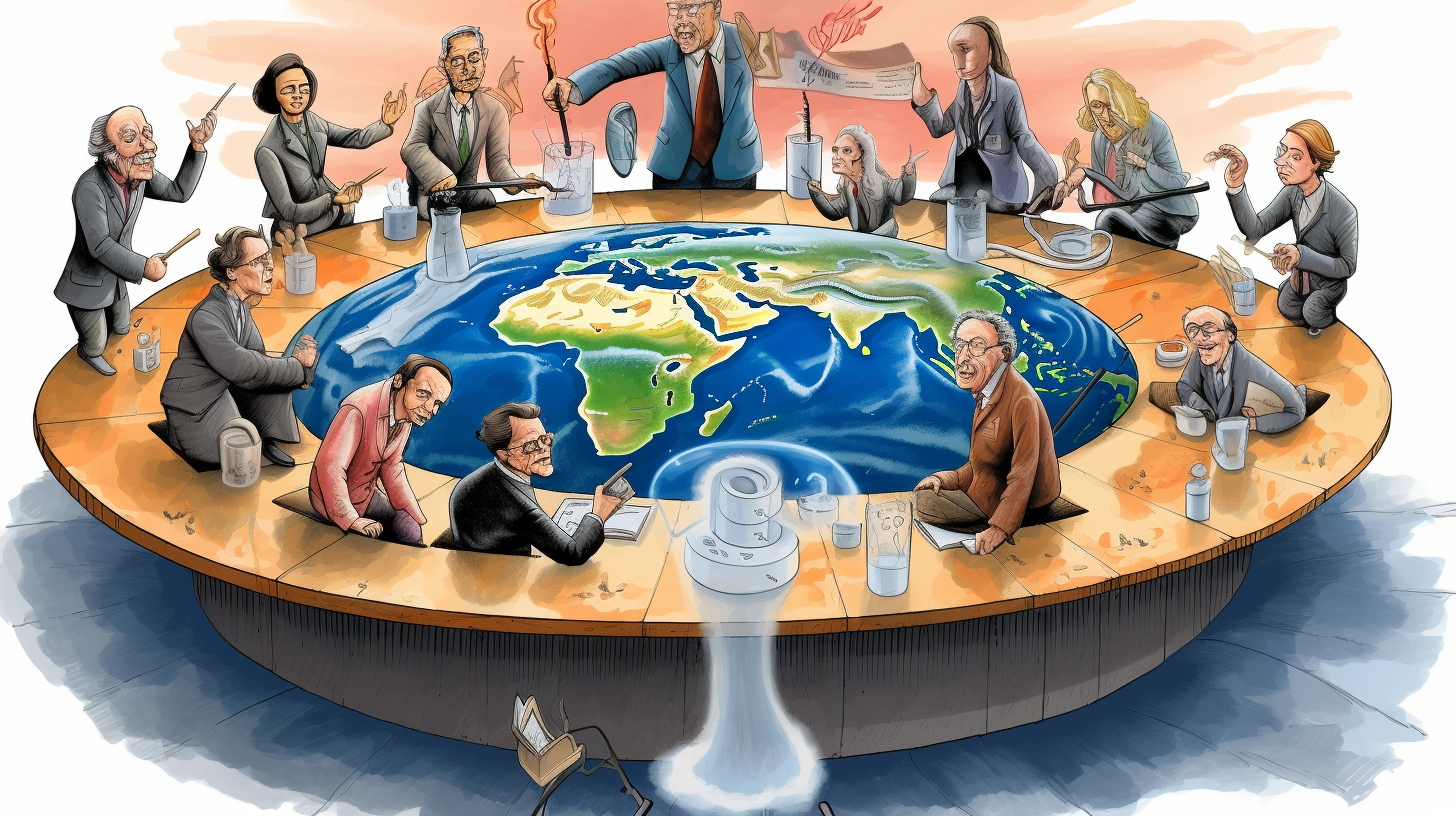
Now there’s two camps of civilians. One believes in global warming of doom, and one not.
Now, true believers desire the solution, which itself presupposes mankind is an environmental menace to these civilians. Global warming of doom exists because the solution does not.
Contrariwise The skeptical camp distrusts the solution and so just believes in global warming of doom. But be careful here. If global warming of doom is true, then it is irrelevant that its followers come to believe it because they desire the solution. Just as it is irrelevant that if a patient believes in the efficacy of his medication because he desires health.
On the other hand, if global warming of doom is false, then it is also irrelevant that its detractors come to disbelieve because they hate the solution.
And there is no symmetry here because who is right and who am wrong depends on whether global warming of doom is true, and it is almost certainly false.
The desperate need, the desperate desire to believe in the solution is why true believers consider questions about the science of global warming, of doom, personal attacks. They lash out when they hear them. Skeptics are greedy or have an animus against the poor believers shriek denier. The science is settled. They lapse into scientific incoherence and make impossible claims like we’re destroying the planet. Or that this is my favorite, that we can stop climate change.
True believers say skeptical Scientists cannot be trusted because these scientists have been have been funded by sources who do not share the true belief. They never see the irony in this. They call for the firing of skeptical scientists or seek to ban their employment. Some true believers have descended into madness and demanded skeptical scientists be prosecuted or imprisoned for crimes against humanity.
And the reason for this childishness is simple. True believers are devoted to the solution to the environment. It is part of their environmental identity. It is who they are. If they cannot be who they are, then they are nothing.
If the science is settled to their satisfaction, unsettling it by conducting new research must be prevented because that new research might prove what cannot be tolerated. And there is no escaping this predicament.
This echoes what Bob said a bit without convincing true believers that environmentalism and the solution are false. And that can’t be done with science. It requires a change in their deepest personal faiths, and that’s a very tough task.
Now, politicians are like civilians in the sense that most of them don’t possess in-depth scientific knowledge. And this is fine. Their skills lay elsewhere, like in relying upon the judgment of people who do have this knowledge. But there is a lesser breed of politician who is happy to profit from the ignorance of the citizens he represents. This politician believes in the solution. Rather, he believes in the civilians belief in the solution. This politician sees himself as the solution. Somebody has to be in charge and it ought to be him.
A member of the House of Representatives wrote letters to employers of several scientists. This member assumed or skeptics and demanded these employers hand over information regarding the scientists, emails, funding sources and so forth. The list was in some error, amusingly, but facts are irrelevant. Political action was what counted.
The member at least, at least had the intelligence to understand that if skeptical scientists successfully refuted global warming of doom, there would be no need for the solution and thus even less need for himself. And that a group of senators wrote letters to scores of companies who might have directly or indirectly funded skeptical scientists.
The senators were displeased about, quote, scientific studies designed to confuse the public and avoid taking action to cut carbon pollution. Confuse the public, prevent the solution. This is lysenkoism, the denouncement of anti-revolutionary research. Lysenko You have to remember, Lysenko not only had scientists fired for politically incorrect research, that was Lenin’s term, but he had several of them executed and banished to labor camps.
But how do we prevent future political attacks? There’s only one way that I see, and that’s to remove the source of power of these scurrilous politicians. And what’s that? True believers. So we’re right back to the hard problem of changing culture itself. Can we convince civilians that big government is not the solution but the problem? And that man, it is not an environmental evil, but a necessary facet of nature. I’m not too sanguine. I think the task is very daunting. Thank you very much.

I am a wholly independent writer, statistician, scientist and consultant. Previously a Professor at the Cornell Medical School, a Statistician at DoubleClick in its infancy, a Meteorologist with the National Weather Service, and an Electronic Cryptologist with the US Air Force (the only title I ever cared for was Staff Sergeant Briggs).
My PhD is in Mathematical Statistics: I am now an Uncertainty Philosopher, Epistemologist, Probability Puzzler, and Unmasker of Over-Certainty. My MS is in Atmospheric Physics, and Bachelors is in Meteorology & Math.
Author of Uncertainty: The Soul of Modeling, Probability & Statistics, a book which calls for a complete and fundamental change in the philosophy and practice of probability & statistics; author of two other books and dozens of works in fields of statistics, medicine, philosophy, meteorology and climatology, solar physics, and energy use appearing in both professional and popular outlets. Full CV (pdf updated rarely).

Support the Broken Science Initiative.
Subscribe today →
One Comment
recent posts
Cancer as a metabolic disease—and the case against the somatic mutation theory
Metabolic health, medical education, and the case for bringing clinicians and coaches together
Metabolic therapies, mitochondrial dysfunction, and what’s holding back progress



Excellent. I’ve tried to have these exact conversations with people I know who were completely overtaken by the propaganda of climate change, covid, etc. I learned a new term, “Lysenkoism” which is EXACTLY what we are seeing today.