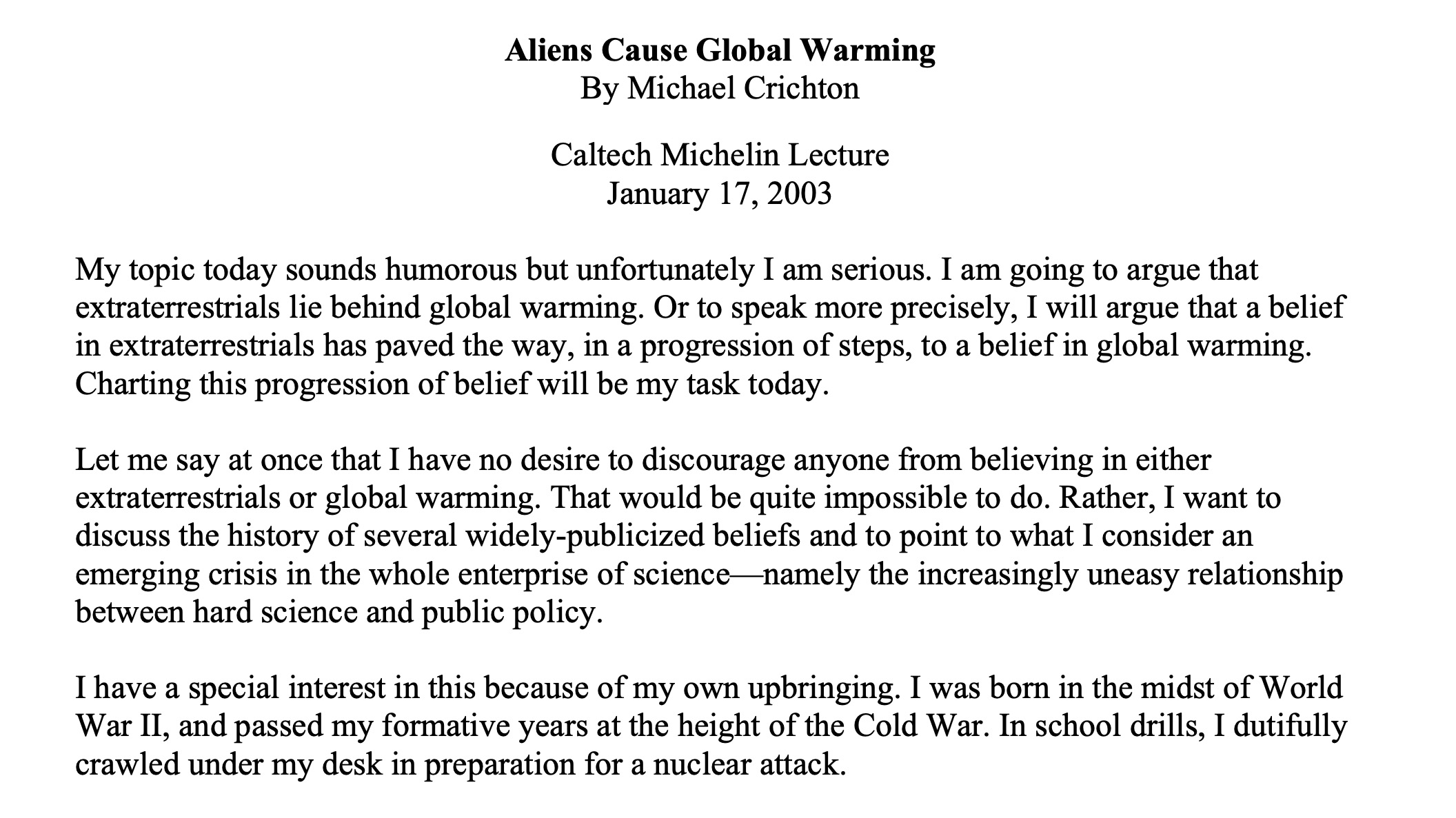
In this 2003 lecture at Caltech, Michael Crichton traces what he sees as a troubling shift in the relationship between science and public policy. Using examples ranging from the search for extraterrestrial intelligence (SETI) to nuclear winter, second-hand smoke, and global warming, he argues that speculative ideas can acquire the appearance of scientific certainty long before the underlying evidence justifies it. According to Crichton, the problem begins when untestable assumptions, computer models, and advocacy efforts are treated as substitutes for direct observation and reproducible results.
A central theme of the talk is his criticism of "consensus science." Crichton argues that scientific progress has historically come from individuals challenging accepted ideas rather than conforming to them. He points to examples such as Ignaz Semmelweis and Joseph Goldberger, whose evidence-based findings were initially rejected by the scientific establishment. In his view, appeals to consensus are often used to shut down debate precisely when important questions remain unresolved.
Crichton reserves particular criticism for the growing reliance on computer models in policy debates. While acknowledging their usefulness, he argues that models are increasingly treated as evidence rather than as tools for generating hypotheses. He questions the ability of scientists to reliably forecast complex systems decades into the future and warns that political objectives can create incentives to overstate certainty, marginalize dissent, and reward research that supports predetermined conclusions.
Crichton argues that science best serves society when it remains independent of politics and advocacy. He calls for greater transparency, independent verification of results, and institutional structures that separate scientific inquiry from policy goals. Scientific authority alone is not enough; ideas must remain open to challenge, and claims must ultimately be tested against reality.
https://stephenschneider.stanford.edu/Publications/PDF_Papers/Crichton2003.pdf








TUESDAY 260623