

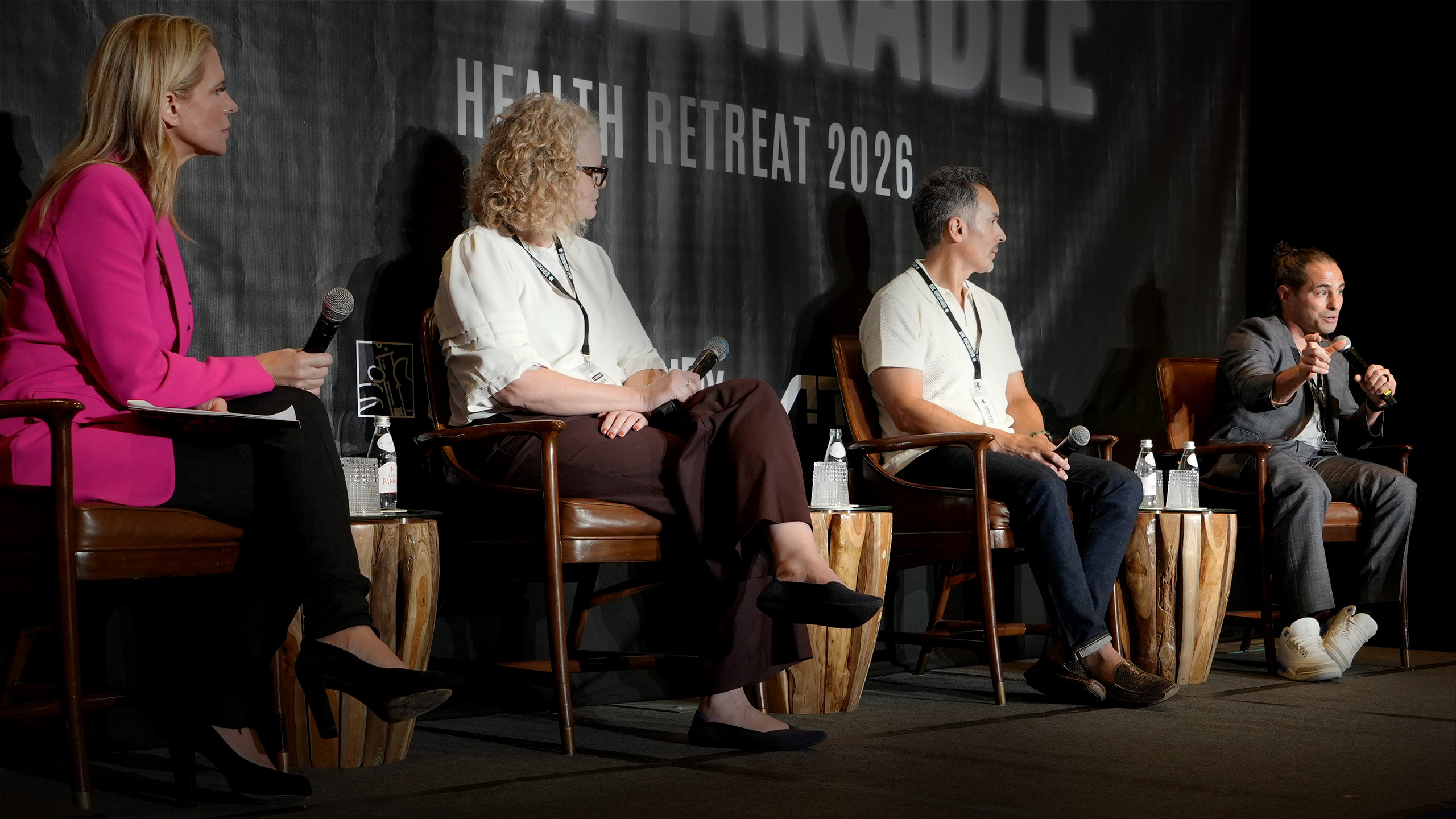
After a morning of Big Pharma executives promoting polypharmacy interventions for chronic disease, Emily Kaplan took the HLTH 2025 stage and changed the conversation entirely. Featured on a panel with True Med cofounder Callie Means and moderated by Axios health reporter Maya Goldman, Kaplan exposed the profit-driven incentives that keep Big Pharma focused on lifelong prescriptions instead of prevention. She revealed the underlying truth: America’s health crisis isn’t caused by a lack of pharmaceuticals, it’s driven by broken systems, misguided nutrition policy, and a medical establishment that profits from disease rather than preventing it.
Representing the Broken Science Initiative (BSI) and its growing network of MetFix affiliates, Kaplan delivered a direct challenge to the medical establishment, in front of an audience of doctors, policymakers, and pharmaceutical executives. She contrasted MetFix’s data-driven, lifestyle-based model with the profit-first culture dominating modern healthcare.
“We have over a hundred affiliates,” Kaplan told the audience. “We’re reversing chronic disease in gyms.” MetFix affiliates are spread across the United States and also operate in the United Kingdom, France, Italy, Canada, Australia, and Switzerland. Each affiliate delivers measurable health outcomes by teaching the biological mechanisms behind disease and recovery, insulin as a storage hormone, and reactive oxygen species (ROS) as the missing link connecting PUFAs to metabolic dysfunction.“When you understand that,” Kaplan said, “you understand that the root cause of chronic disease comes from the food you eat and the choices you make.”

“We’re educating the average person that you can go into a MetFix gym and, for your gym membership, reverse type 2 diabetes. We’re reversing it in eight weeks,” she said. “Health doesn’t need to be so complicated. We just need to get back to basics, what is the biological mechanism that causes disease or causes health?”
Kaplan illustrated the problem with a heartbreaking example. “Right now, one in ten American kids has fatty liver,” she said. “For those who don’t know, fatty liver used to only be seen in alcoholics. Doctors would say, ‘You have to cut off the booze,’ and the patient would say, ‘I don’t drink.’ They didn’t believe them because they’d never seen it in a non-drinker. Now we see it in kids… because of the sugar in the diet.”
Furthermore, she emphasized that this is not a political issue. “Everybody wants healthy kids. Your kid is not a Democrat or a Republican. We need to come together around this.” Her appeal was grounded in shared humanity and common sense, a reminder that families, coaches, and doctors all want the same outcome: real health, not lifelong symptom management.
Kaplan explained that MetFix’s design makes it both scalable and personal. “Scaling MetFix is actually really easy because it’s an affiliate model,” she said. “It’s a low barrier to entry, a licensing fee and education, but the change happens locally. You reverse type 2 diabetes in eight weeks, and that person becomes your biggest advocate.” Affiliates, she added, “become real professionals in their communities.”
The Broken Science Medical Society extends this education to healthcare professionals, roughly half physicians and half patients, teaching them how to critically read randomized controlled trials and identify manipulation, bias, and statistical misdirection. “We have to remind people that medicine is about treating the patient in front of you,” Kaplan said, “not making population-level policy decisions that ignore the individual.” Through the society, practitioners are rediscovering the foundations of real science: observation, mechanism, and predictive validity, not authority, consensus, or p-values.
At its core, Kaplan’s message was both urgent and optimistic. The health crisis Americans face, rising rates of obesity, diabetes, and chronic disease, is real, but it’s also reversible. “We can correct these things,” she said. “Health isn’t a mystery, it’s mechanics.” The path forward isn’t another drug or new policy guideline; it’s education, transparency, and action grounded in biology.

Kaplan’s vision for the Broken Science Initiative and MetFix is to restore trust in science through results, predictive, observable, repeatable outcomes. By anchoring the movement in gyms, coaches, and doctors, she’s building a new healthcare infrastructure that doesn’t wait for approval from failed institutions. It earns trust by working, by producing measurable, repeatable health reversals in real people.
The call to action she left the audience with was unmistakable: join the movement. Visit a MetFix gym and experience measurable change in your own health. If you’re a gym owner or coach, become an affiliate and bring disease reversal to your community. And if you’re a doctor or healthcare professional ready to reclaim your power, join the Broken Science Medical Society. Real science is grounded in prediction, not politics, and MetFix is showing what that looks like in action


Mia is a health and technology writer who covers cybersecurity and AI literacy. She’s also a software engineer, web developer, and marketer, blending technical execution with clear, engaging storytelling to make complex ideas accessible and useful.

Support the Broken Science Initiative.
Subscribe today →
2 Comments
recent posts
Metabolic health, medical education, and the case for bringing clinicians and coaches together
At the 2026 Unbreakable Health Retreat in Miami, Emily Kaplan hosted a panel with Bob Kaplan, Professor Thomas Seyfried, and Dr. Derek Lee on what it means to treat cancer as a metabolic disease. They discussed the glucose-ketone index (GKI), nutritional ketosis, and strategies aimed at restricting the fuels cancer cells depend on while considering how metabolic therapy can fit alongside standard cancer treatment.
The conversation also addressed the practical realities patients face when trying to pursue a metabolic approach within the conventional oncology system, including questions about nutrition, repurposed drugs, inherited cancer risk, and how to evaluate different treatment options. Seyfried and Lee connected these clinical questions back to mitochondrial dysfunction, fermentation, and the metabolic vulnerabilities that may offer additional targets for cancer treatment.
An abbreviated version of this discussion is available here, for free.
At the 2026 Unbreakable Health Retreat in Miami, Professor Thomas Seyfried presented the case that cancer is fundamentally a mitochondrial metabolic disease rather than primarily a genetic one. He contrasts the dominant somatic mutation theory with a metabolic model in which impaired mitochondrial respiration drives a shift toward fermentation, dysregulated cell growth, and the mutations commonly associated with cancer.
Citing the work of Otto Warburg and research from his lab at Boston College, Seyfried explains how cancer cells rely heavily on fermentable fuels—particularly glucose and glutamine—and why mitochondrial dysfunction sits upstream of many of the genetic abnormalities seen in tumors. He also discusses reactive oxygen species, altered cellular signaling, and the role of mitochondria in regulating cell growth and behavior.
The presentation then turns to the therapeutic implications of this model. Seyfried explains strategies aimed at placing tumor cells under metabolic stress by restricting the fuels they depend on, including ketogenic metabolic therapy and approaches targeting glucose and glutamine. For Seyfried, the therapeutic target follows directly from the biology: restrict the fuels cancer cells depend on, exploit their metabolic weaknesses, and treat mitochondrial dysfunction as the central feature of the disease.
An abbreviated version of this discussion is available here, for free.
MetFix and BSI Members can view the full 54-minute video.


This is the kind of leadership we need! Someone who is willing to sit in a room filled with Big Pharma execs and say, “we are fixing what is broken with diet and exercise.”
Proud, humbled and honored to be part of her team.