
CFHQ
Santa Cruz, CA
USA
01 Mar 07
OPS 09
FRAGO 08 to OPOrd 01 — OP GRINDER
Ref: A. OPORD 01 01 Jul 06
Task Organization: Annex A
1. SITUATION
No Change.
2. MISSION
“SHANE”
Complete as many rounds as possible in 20 minutes:
8 inverted burpees
21 squats
12 burpees.
3. EXECUTION
a. Concept of Operations.
- Intent. Complete as many rounds of the exercises in 20 minutes as possible in a safe manner. This is a four-person-team team “time-specific” workout. The purpose of this workout is to develop cohesion and combat fitness under fatigue conditions through shared hardship, challenges, and competition.
- Scheme of Maneuver. The platoon will be divided into as many teams of four as possible. Each team will require a wall or other stable object to conduct the inverted burpees against. All teams will start at the same time. Each exercise must be completed before moving to the next one (all 8 inverted burpees must be finished before starting the squats and all squats finished before starting the burpees). The soldiers can take a rest at any time during the workout. Each team has to complete as many rounds as possible in the 20 minutes. The total number of complete rounds for each team member will be added together to obtain the total score for the team. For example, if soldier “A” completes 12 rounds, soldier “B” 15 rounds, soldier “C” 13 rounds, and soldier “D” 9, the total score for the team woul
- Main Effort. The safety of all personnel, and the development of unit cohesion and combat fitness through shared challenge and hardship
- End State. The safe and successful completion of all exercises.
b. Coordinating Instructions.
- Team Organization. Squad leaders can organize their soldiers however they wish. It is a leadership decision on how best to deploy each soldier to accomplish the mission.
- Scaling. The workout can be conducted in PT gear or full battle gear to include vests with plates, depending on the fitness levels of your soldiers. The number of reps can be increased or decreased based on the skill level of your troops.
- Scoring. The final score for each team is the total of completed rounds by all members of the team; partial rounds are not counted. For example, if at the end of 20 minutes, a soldier has completes 12 rounds plus 6 inverted burpees of round 13, his score is 12. The team that has the most total rounds comes in first.
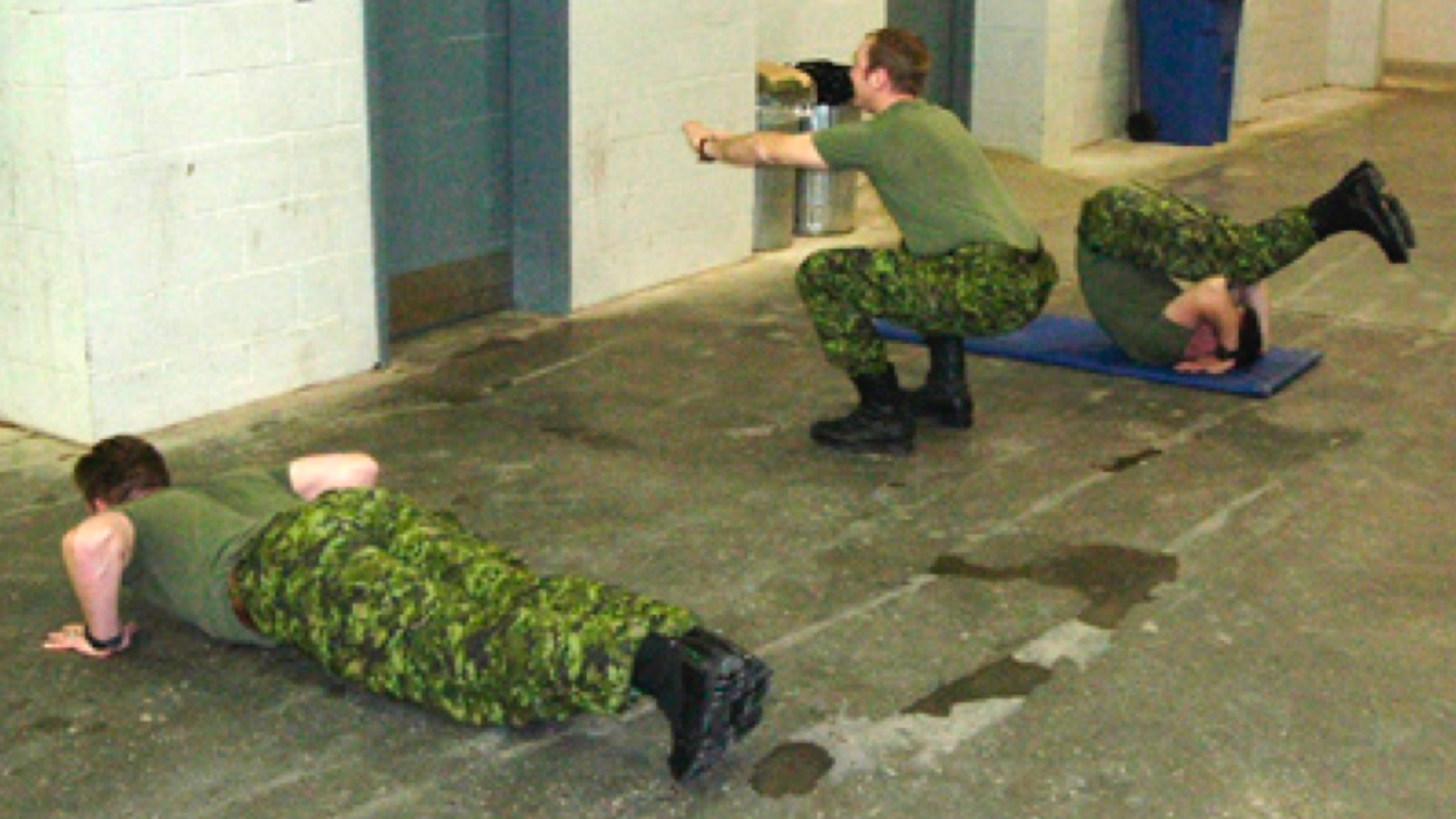
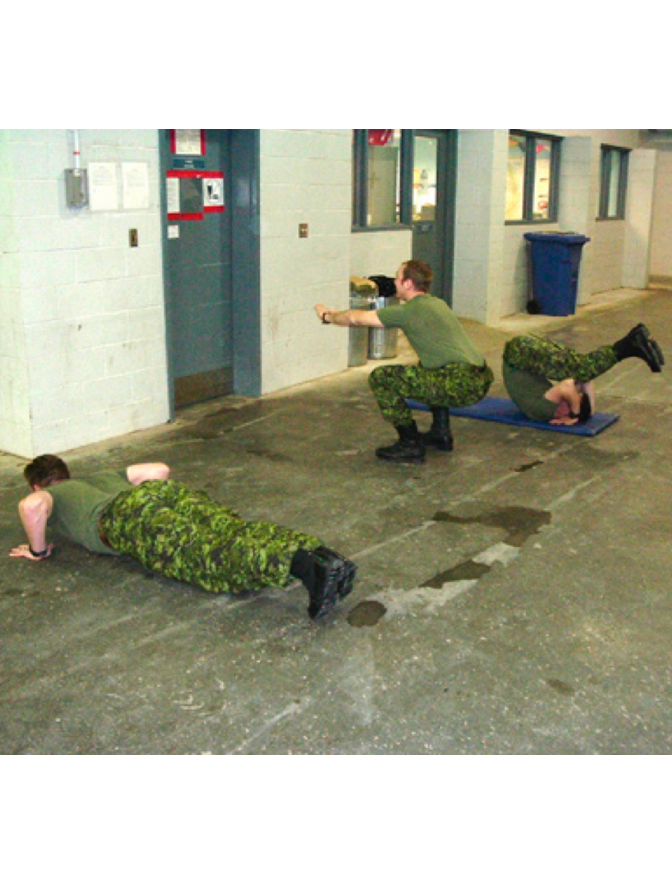
- Inverted Burpee. There are two methods of conducting the inverted burpee. For the first variation, the soldier begins supine on the ground, kips to standing, and then kicks up to handstand. However, few soldiers will be capable of kipping up to a standing position from their backs. For the second variation, the soldier begins in a standing position, squats down and rolls onto his back, and then, using momentum, rolls up to his feet and into a handstand (see Annex C). The two inverted burpee variations involve equal or greater work and greater skill than the traditional burpee.
- Safety. Ensure that all equipment is checked and serviceable before conducting the workout and that all soldiers are proficient in the required exercises. Safety is every member’s responsibility.
- Follow-on Tasks. The next workout will require 2 x .50 Cal ammo cans and 2 x 25mm ammo cans per each four-man team. Soldiers must be proficient in the dead-lift, push-press, and thruster.
4. SERVICE SUPPORT
a. Equipment Requirements. Each four-person team will require a wall or other tall, sturdy object to conduct the inverted burpees against; also, the use of a mat is recommended if conducting the inverted burpee on a hard surface such as a cement or wood floor.
b. Time and Repetition Recording. One stopwatch for all teams and a method of
recording each team’s rounds.
5. COMMAND AND SIGNAL
a. Timer/Score Recorder. Only one timekeeper is required for all teams. All four-man teams begin and end the workout at the same time. It is recommended that at least one person per team start his stopwatch to act as a backup in case the primary timekeeper’s stopwatch fails. A method of recording each team’s rounds is also required.
b. Instructor/Coach. To ensure proper conduct of the workout, use of correct exercise form, and safety of execution, a designated member of the platoon can fill this billet.
Annexes
Annex A – Workout Diagram (AOO)

Annex B – Exercises
Photos 1-6: Inverted burpee




This article, by BSI’s co-founder, was originally published in The CrossFit Journal. While Greg Glassman no longer owns CrossFit Inc., his writings and ideas revolutionized the world of fitness, and are reproduced here.
Coach Glassman named his training methodology ‘CrossFit,’ which became a trademarked term owned by CrossFit Inc. In order to preserve his writings in their original form, references to ‘CrossFit’ remain in this article.

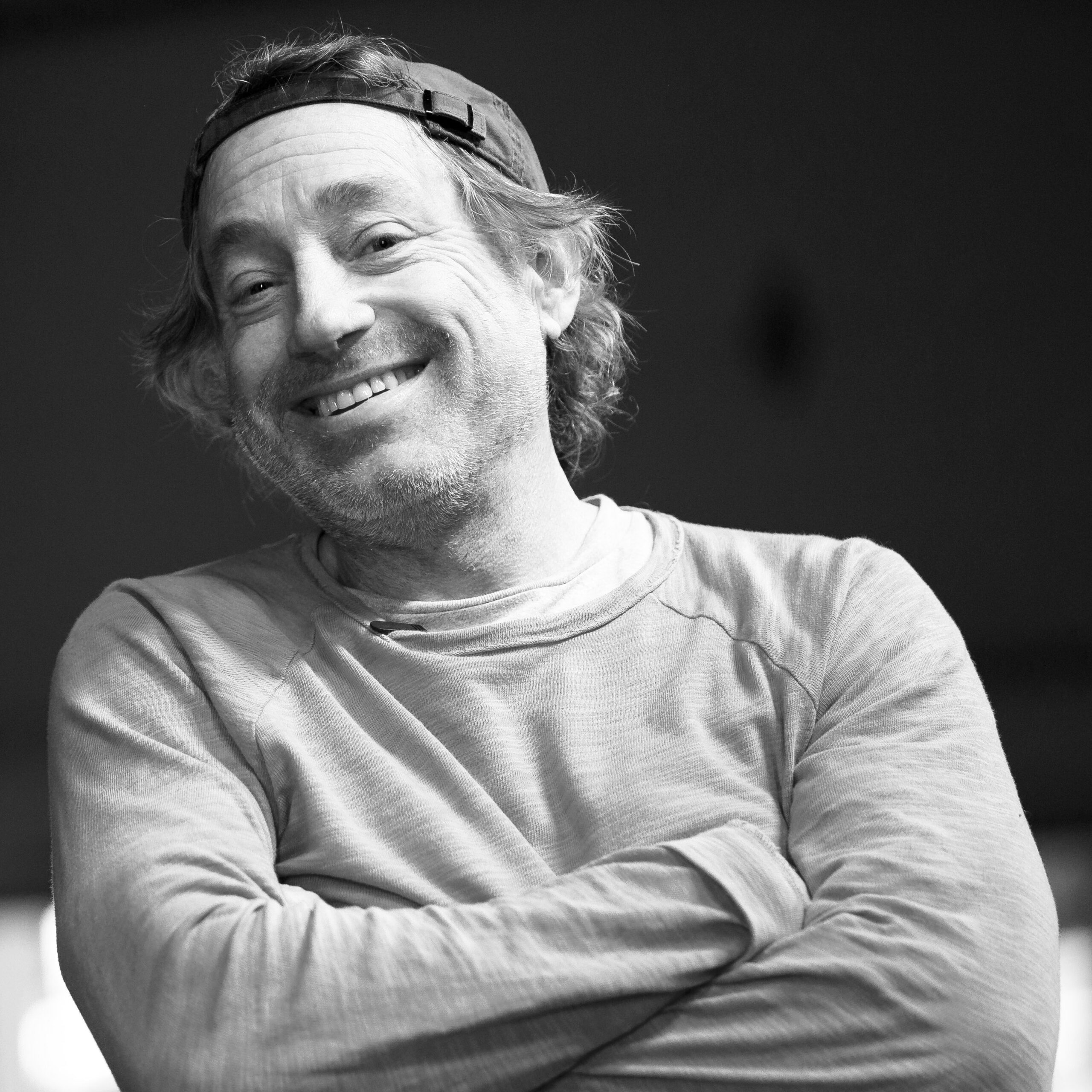
Greg Glassman founded CrossFit, a fitness revolution. Under Glassman’s leadership there were around 4 million CrossFitters, 300,000 CrossFit coaches and 15,000 physical locations, known as affiliates, where his prescribed methodology: constantly varied functional movements executed at high intensity, were practiced daily. CrossFit became known as the solution to the world’s greatest problem, chronic illness.
In 2002, he became the first person in exercise physiology to apply a scientific definition to the word fitness. As the son of an aerospace engineer, Glassman learned the principles of science at a young age. Through observations, experimentation, testing, and retesting, Glassman created a program that brought unprecedented results to his clients. He shared his methodology with the world through The CrossFit Journal and in-person seminars. Harvard Business School proclaimed that CrossFit was the world’s fastest growing business.
The business, which challenged conventional business models and financially upset the health and wellness industry, brought plenty of negative attention to Glassman and CrossFit. The company’s low carbohydrate nutrition prescription threatened the sugar industry and led to a series of lawsuits after a peer-reviewed journal falsified data claiming Glassman’s methodology caused injuries. A federal judge called it the biggest case of scientific misconduct and fraud she’d seen in all her years on the bench. After this experience Glassman developed a deep interest in the corruption of modern science for private interests. He launched CrossFit Health which mobilized 20,000 doctors who knew from their experiences with CrossFit that Glassman’s methodology prevented and cured chronic diseases. Glassman networked the doctors, exposed them to researchers in a variety of fields and encouraged them to work together and further support efforts to expose the problems in medicine and work together on preventative measures.
In 2020, Greg sold CrossFit and focused his attention on the broader issues in modern science. He’d learned from his experience in fitness that areas of study without definitions, without ways of measuring and replicating results are ripe for corruption and manipulation.
The Broken Science Initiative, aims to expose and equip anyone interested with the tools to protect themself from the ills of modern medicine and broken science at-large.

Support the Broken Science Initiative.
Subscribe today →
recent posts
If you're seeing this page, you are not currently logged into a profile with access to Affiliate Owners / Medical.
At the 2026 Unbreakable Health Retreat in Miami, Emily Kaplan hosted a panel with Bob Kaplan, Professor Thomas Seyfried, and Dr. Derek Lee on what it means to treat cancer as a metabolic disease. They discussed the glucose-ketone index (GKI), nutritional ketosis, and strategies aimed at restricting the fuels cancer cells depend on while considering how metabolic therapy can fit alongside standard cancer treatment.
The conversation also addressed the practical realities patients face when trying to pursue a metabolic approach within the conventional oncology system, including questions about nutrition, repurposed drugs, inherited cancer risk, and how to evaluate different treatment options. Seyfried and Lee connected these clinical questions back to mitochondrial dysfunction, fermentation, and the metabolic vulnerabilities that may offer additional targets for cancer treatment.
An abbreviated version of this discussion is available here, for free.
At the 2026 Unbreakable Health Retreat in Miami, Professor Thomas Seyfried presented the case that cancer is fundamentally a mitochondrial metabolic disease rather than primarily a genetic one. He contrasts the dominant somatic mutation theory with a metabolic model in which impaired mitochondrial respiration drives a shift toward fermentation, dysregulated cell growth, and the mutations commonly associated with cancer.
Citing the work of Otto Warburg and research from his lab at Boston College, Seyfried explains how cancer cells rely heavily on fermentable fuels—particularly glucose and glutamine—and why mitochondrial dysfunction sits upstream of many of the genetic abnormalities seen in tumors. He also discusses reactive oxygen species, altered cellular signaling, and the role of mitochondria in regulating cell growth and behavior.
The presentation then turns to the therapeutic implications of this model. Seyfried explains strategies aimed at placing tumor cells under metabolic stress by restricting the fuels they depend on, including ketogenic metabolic therapy and approaches targeting glucose and glutamine. For Seyfried, the therapeutic target follows directly from the biology: restrict the fuels cancer cells depend on, exploit their metabolic weaknesses, and treat mitochondrial dysfunction as the central feature of the disease.
An abbreviated version of this discussion is available here, for free.
MetFix and BSI Members can view the full 54-minute video.


