
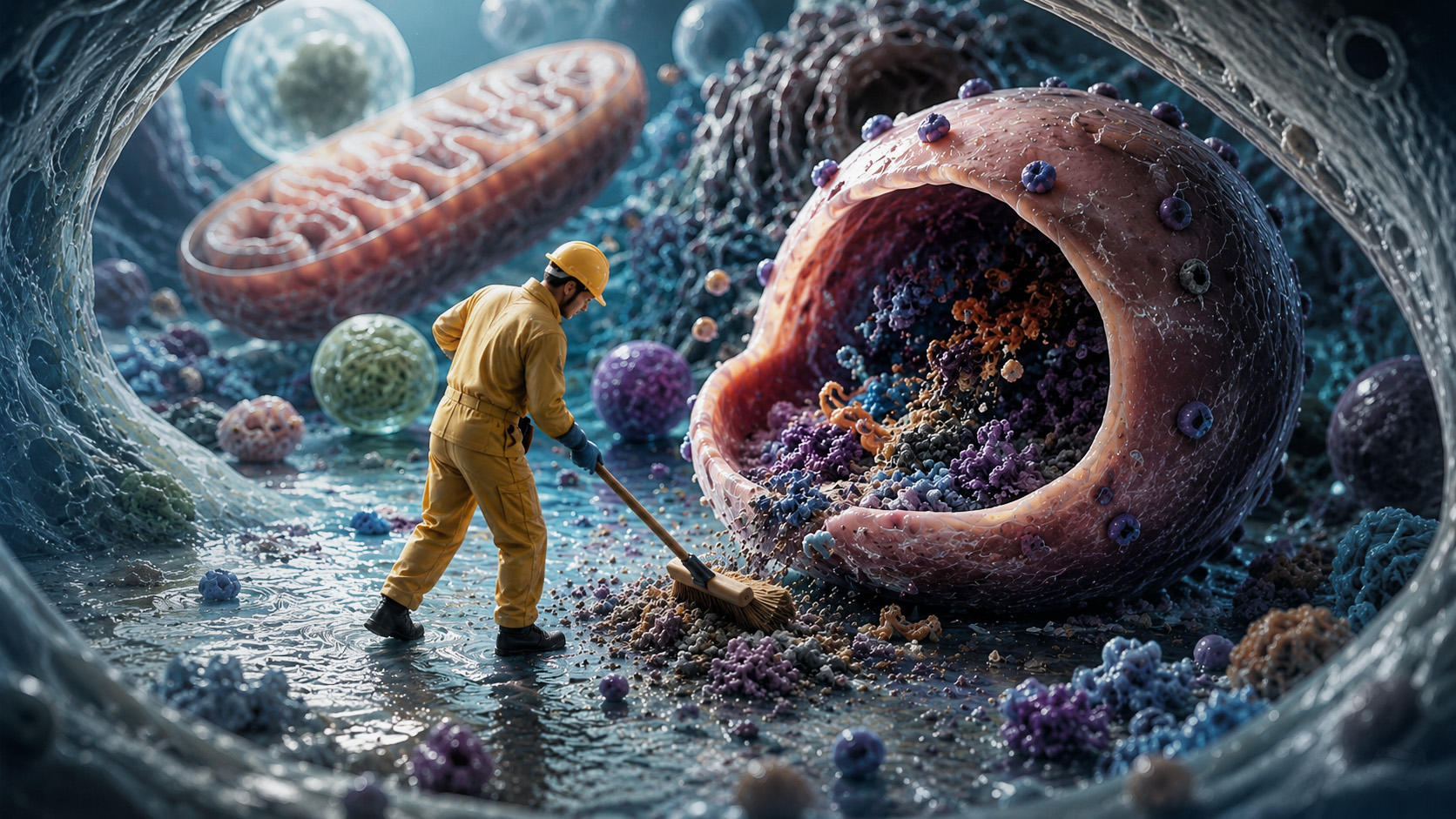
A recent pair of articles (1, 2) in Nature Metabolism by Ana Maria Cuervo’s group at Albert Einstein College of Medicine in New York points to a potential new pathway for preventing sarcopenia (muscle loss) with aging. These mouse studies (and you know the caveat there) appear to show that the waning of a normal physiologic mechanism for cleaning the junk proteins out of muscle and other cells may be at the root of sarcopenia and amping it back up may prevent further decline (and why wouldn’t it?) The interesting element is that the Einstein researchers have further collaborated with scientists at the National Institute of Aging (NIA) to verify that the connection of this pathway to sarcopenia and the mechanism by which it acts hold up in humans as well.
What is CMA?
The pathway under examination is called chaperone‑mediated autophagy (CMA). It’s a selective cleanup system inside cells that tags damaged or misfolded proteins and shuttles them into the lysosomes (little intracellular vats of acidic digestive enzymes that degrade proteins and foreign matter) for disposal. Think of it as a highly specific recycling line that only takes certain labeled proteins, rather than just a bulk‑dump of everything that needs recycling.
Once it’s done its job, it sends the reusable amino acids back into the AA pool to be repurposed. With age, in both mice and men, CMA declines, the activity of the membrane receptor on the lysosome that unlocks the door to let these tagged proteins into the hopper wanes, and the whole cleanup process becomes slower and less efficient. This means more junk proteins build up in muscle cells, brain cells, and other cells, which can contribute to sarcopenia, weakness, reduced neural resilience, and cognitive decline over time.
But the mouse data shows that the flagging of the CMA system begins long before there are any overt signs of muscle loss and weakness or forgetting where you put your keys, which suggests, at least, that intervening earlier in life to nip the decline in CMA might be even more beneficial, preserving muscle mass, strength, and cognition rather than trying to halt their loss later.
And ketosis may help keep that CMA cleanup line humming like a well-oiled machine.
Research from as far back as 2005 shows that ketone bodies, especially beta‑hydroxybutyrate, can stimulate CMA in cells and isolated lysosomes, suggesting that the metabolic state of fasting or sustained nutritional ketosis through diet activates this selective garbage‑removal pathway. In practical terms, that means that in aging, where CMA is already slipping, a well‑structured ketogenic diet may be key to helping cells maintain a cleaner environment by enhancing protein homeostasis (i.e., the cell’s system for keeping its proteins in the right shape, quantity, and location at the right time). That doesn’t mean ketosis is a magic anti‑aging bullet, though it may be, but it does make a strong case for viewing nutritional ketosis as a plausible means to support cellular housekeeping, not just for shedding fat. (And a plausible way to preserve strength, muscle mass, and brain fitness longer if adopted before the decline begins.)
What else does ketosis do?
It supports the all-important cellular power plants: the mitochondria, which with age often lose efficiency, producing less ATP and handling oxidative stress less well. This shows up in the gym as slower recovery, weaker endurance, and less snap in performance, even if strength on a barbell stays decent. In the brain, the same energetic drift can contribute to mental fog and slower cognitive processing. A ketogenic diet, by shifting fuel from glucose toward fatty acids and ketones, can boost mitochondrial efficiency and metabolic flexibility, essentially helping cells burn fuel more cleanly and adapt to different energy demands.
The mitochondrial angle is especially relevant for skeletal muscle, where age-related loss of mitochondrial mass and function contributes to sarcopenia and reduced endurance. Reviews and human biopsy data support the idea that ketogenic adaptation can improve mitochondrial function in older or metabolically impaired states. (And since a diet higher in quality fat can bring more mitochondria online, it’s important to impress that fact on an aging athlete who may be conditioned (incorrectly) to fear eating fat for all the wrong reasons.)
In muscle, ketogenic patterns have been linked to preserved strength and endurance in aging models, and in human trials a ketogenic diet can support better metabolic markers and exercise tolerance after adaptation. The takeaway for trainers is that ketosis can be a tool that helps cells run cleaner at the mitochondrial level, which may support better performance, recovery, and long‑term resilience, especially as a client moves past that mid-twenties peak.
Ketosis damps down the inflammasome, as well. Chronic low‑grade inflammation is a quiet but powerful driver of aging symptoms, resulting in slower recovery, stiffer joints, and brain fog that doesn’t fully clear between sessions. A big player in this is the NLRP3 inflammasome, an immune switch that can ramp up inflammatory cytokines such as IL‑1β when cells are stressed by metabolic overload, oxidative damage, or leaky mitochondria. When that system is chronically turned on, it can wear down muscle, brain, and cardiovascular health over time.
Ketosis appears to act like a gentle circuit breaker for this system. Studies show that ketogenic and fasting‑style interventions can reduce NLRP3 inflammasome activation and downstream inflammation, in part because beta‑hydroxybutyrate directly modulates inflammatory signaling and in part because lower insulin and better metabolic control ease the load on the immune system. In practical terms, this means that a well‑crafted ketogenic diet may help their bodies recover with less systemic inflammation, less residual soreness, and better neural clarity between heavy training blocks. It’s not about turning off inflammation completely; it’s about dialing down the chronic background noise that can sabotage long‑term performance and health.
The emerging picture from Cuervo’s work, along with the broader ketosis literature of researchers such as Jeff Volek and Stephen Phinney, is that sarcopenia and age-related decline in muscle and brain function may not simply be inevitable wear and tear, but partly a consequence of the waning of a finely tuned cellular cleanup system—CMA—that begins slipping long before weakness becomes obvious.
By supporting CMA, enhancing mitochondrial efficiency, and soothing the overactive inflammasome, a well-constructed, whole-food ketogenic diet appears to offer a biologically coherent way to preserve protein homeostasis, metabolic resilience, strength and muscle mass, and cognitive clarity in aging. If the metabolic cleanup begins well before the decline is evident, that may translate into a longer, stronger, sharper window of physical and mental performance.

Physician, author, blogger, and lecturer on the art and science of low-carbohydrate nutrition, using food as a remedy for the diseases of modern civilization: obesity, diabetes, heart disease, and the myriad disorders of the insulin resistance/metabolic syndrome complex.

Support the Broken Science Initiative.
Subscribe today →
One Comment
recent posts
Cancer as a metabolic disease—and the case against the somatic mutation theory
Metabolic health, medical education, and the case for bringing clinicians and coaches together

Metabolic therapies, mitochondrial dysfunction, and what’s holding back progress



I’d be interested to know whether there’s evidence that a ketogenic diet, or periodic ketosis (induced by 36 hours or so of fasting) can help repair damage to the retina in age-related macular degeneration.