
Greg Glassman, MetFix’s CoFounder, did something the fitness world had spent decades circling. He gave fitness a definition you could measure. He called it work capacity across broad time and modal domains, and he measured using the principle of power: force times distance, divided by time. Move a heavier load a longer distance in less time and your power output climbs, and so does your fitness by his definition. For the first time you could compare Monday’s workout to last Thursday’s and measure your own progress over time or compare your scores to anyone else in the community. You could know whether you were getting fitter or only telling yourself you were.
But your power output as an external measurement didn’t tell us everything about your internal metabolic state.
We’ve relied on proxy measurements; weighing an array of test results that are symptomatic of health or illness: Cholesterol, blood pressure, resting heart rate, body weight, body fat, A1C, CRP, steps, hours of sleep, types of sleep, and so forth. Ask a person how metabolically healthy they are and you get a shrug, a subjective retort or a lab panel without an action plan. The one thing most of us actually want to know, whether the machinery is running clean or breaking down, has never had a dial you could read at home.
A new paper makes the case that this problem has been solved. “The glucose ketone index,” published in Frontiers in Science on July 14, 2026, and lead-authored by Derek Lee with Thomas Seyfried and colleagues in the Biology Department at Boston College, proposes a single measurement for exactly that. The glucose ketone index, or GKI, is the ratio of the glucose in your blood to the ketones in it, specifically beta-hydroxybutyrate. Both can be captured by fingerpricks of blood samples, and soon commercially available continuous monitors. You divide one by the other. You get one number, a score of sorts that can be plotted on their index.
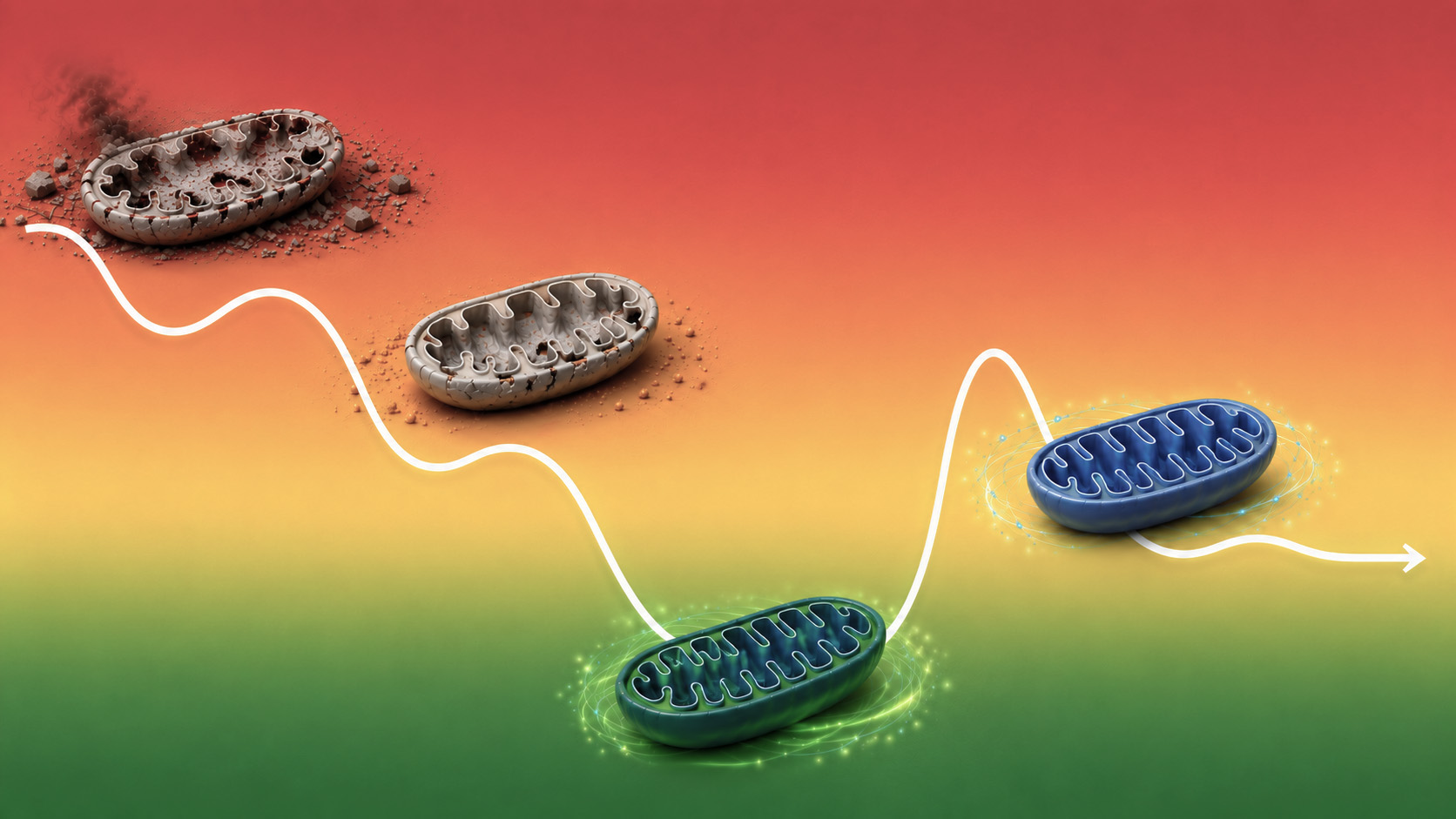
The paper’s premise, which aligns exactly with MetFix’s education protocol, is that a long roster of diseases we treat as separate, cancer, type 2 diabetes, obesity, cardiovascular disease, Alzheimer’s, and mental health all trace back to the same failure inside the cell. The authors define it plainly: mitochondrial dysfunction is “insufficient adenosine triphosphate (ATP) production through oxidative phosphorylation in response to energy demand.” When the mitochondria are healthy, they run elongated and dense with the internal folds where energy is made, and they produce a lot of ATP and little waste. When they are damaged, those folds break down, energy production falls, and the cell throws off far more reactive oxygen species, the molecules that corrode it from the inside. Chronic disease is now behind 8 of the 10 leading causes of death in the United States. Three in four American adults carry at least one chronic condition, and ninety cents of every dollar in the country’s $5.3 trillion annual health care bill goes to people who have one. Cancer is on the verge of passing heart disease for the top spot, with more than 626,000 deaths projected this year, over 1,700 a day. The paper’s argument is that this one broken process, mitochondrial dysfunction, is showing up under a dozen different names.
Here is where the ketone comes in. When the body runs low on glucose and starts producing ketones instead, it switches to a fuel that runs cleaner. The authors don’t mince words on this. Beta-hydroxybutyrate, they write, has been “The ketone body β-hydroxybutyrate (βHB) has been designated a ‘super fuel’ because it is more effective than either pyruvate or fatty acids in enhancing the bioenergetic efficiency of mitochondrial ATP production.” It yields more energy, it throws off fewer of those corrosive oxygen species, and it quiets several of the pathways that drive chronic disease. Burn more ketone and less sugar, and by this model you are running the engine the way it was built to run.
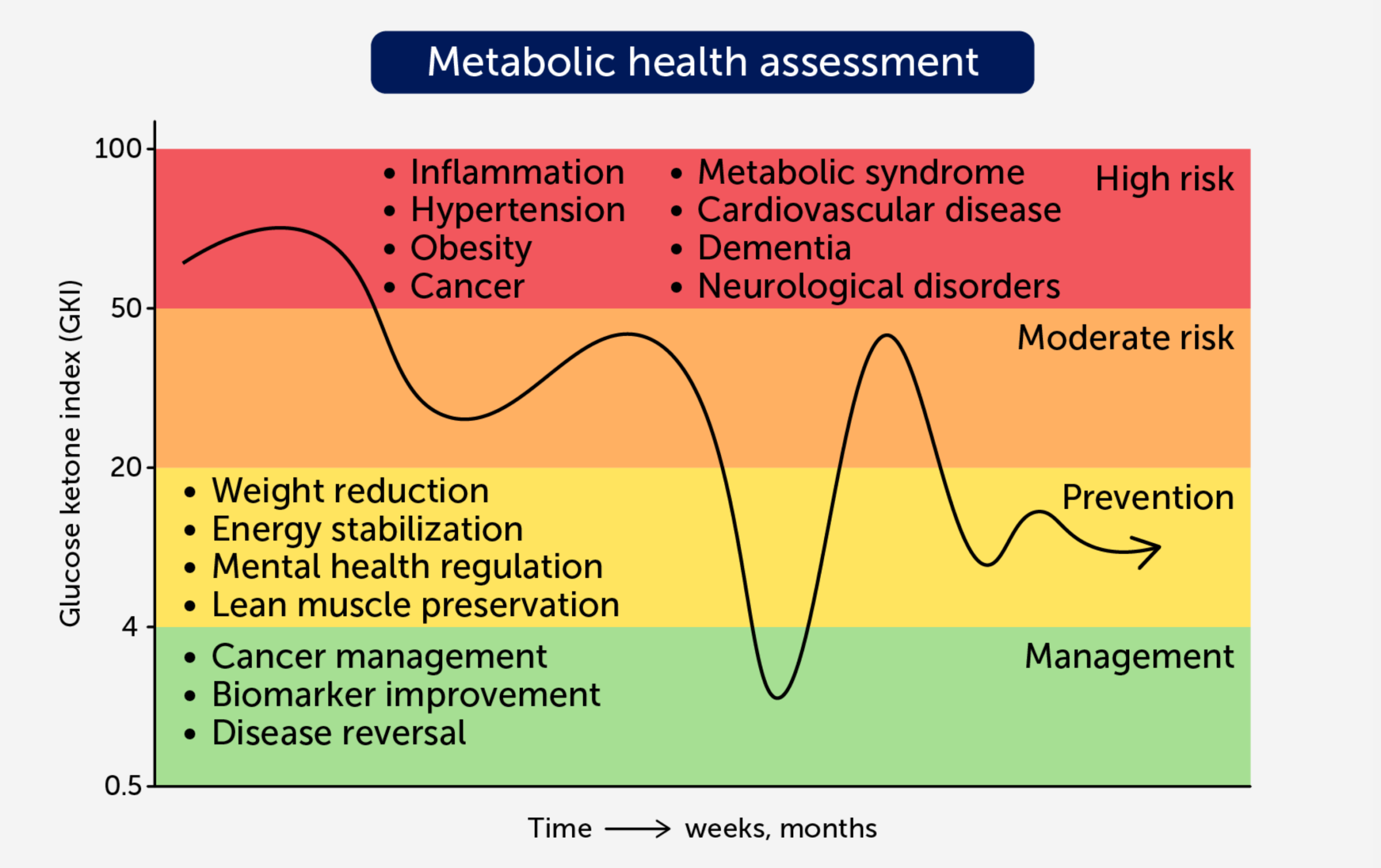
The ratio predicts the state you’re in. Someone eating the standard Western way might sit at a GKI of 50, glucose high and ketones near zero. Someone in moderate nutritional ketosis lands around 10. Someone deep in it, the range these authors have used to help manage brain cancer, sits near 2 or below. Low is favorable. High signals risk. As we teach at MetFix, your goals will dictate what zone you want to be in. If you have Type 2 Diabetes, Cancer or another chronic disease and are determined to do something about it you want to be in the green zone most of the time. But for people who are not suffering the goal is to be able to move in and out of these zones without much effort, what we call metabolic flexibility.
I joined Doctor Seyfried and Morgan Devlin who works with him for a YouTube chat about the new index and how MetFix is partnering with the lab to help educate people on this new tool. During our discussion, Dr. Seyfried made the point that there are times when we should be okay being in the red zone, like on your birthday or another special occasion, once in a while when life calls for it. But the goal should be that it’s a rare event and not a chronic state.
The paper lays the whole span out as a color-coded chart, red through green, built to be read and acted on by the individual. And because it is one ratio rather than a glucose reading alone, it compares one person to the next, which is the entire point of a measurement. The authors state: “We assert that the GKI could represent a parsimonious, individualized, and impartial biomarker for use, together with exercise and nutrition, to support therapeutic strategies to prevent and manage mitochondrial dysfunction, which contributes to cancer and many chronic diseases.” Said plainly, it is one number you can act on.
This is the number MetFix has been waiting for.
The GKI predicts your future metabolic health with a single ratio you can watch move, week over week, in your own kitchen, and lower intentionally with food and exercise. My cofounder built a global fitness movement on one idea, that what gets measured gets trained. We intend to do the same thing with health.
That is the spine of our two-day Foundations Seminar. Greg professionalized the personal trainer by putting coaches in a room for a weekend and teaching the mechanics from the ground up, and we built MetFix Foundations the same way. Over two days, in person, we walk through exactly what this paper lays out: how chronic disease actually manifests in the body, starting from damaged mitochondria and working outward to the conditions people get diagnosed with years later. We show what the fuel switch from glucose to ketones does inside the cell, and now we will put the GKI in people’s hands: how to measure it off a fingerprick, how to bring the number down with food and exercise, and how to keep it in a healthy range once it’s there. The paper is the peer-reviewed articulation of the premise we teach. The seminar is where you learn to do something about it. Our soon to be released online classes will each echo these fundamental teachings in a variety of ways delivered for various groups from peri-menopausal women to teenagers to those in our first responder community.
Thomas Seyfried has spent his career arguing that cancer is a metabolic disease, and he’s become a close friend. When he asked me to join him for a video on his channel to walk through how MetFix and his work fit together, it was a moment he and I have discussed for years coming to fruition. If you want to see where this is going, watch that conversation, then read the paper yourself. It’s open access. The way to measure your health has been sitting in your blood the whole time. Now there’s a way to read it and act on it. MetFix will lead this effort to educate coaches and doctors on our new quantifiable metric of health.
Sources:
- Lee DC, Duraj T, Cooper ID, Maroon JC, Smith K, Abdel-Hadi W, Omene E, Evangeliou AE, Seyfried TN. “The glucose ketone index: a proposed quantitative biomarker to support cancer and chronic disease prevention and management.” Frontiers in Science, 2026, doi:10.3389/fsci.2026.1763395. Source for the GKI definition and ranges, the mitochondrial-dysfunction premise, the “super fuel” and “parsimonious, individualized, and applicable biomarker” quotes, the “8 of 10 leading causes of death” figure, and the 2026 cancer projection (>626,000 US deaths, >1,700/day), which the paper draws from Siegel et al., Cancer Statistics 2026.
- CDC, About Chronic Disease: “Three in four American adults have at least one chronic condition.”
- CDC, Fast Facts: Health and Economic Costs of Chronic Conditions: “Ninety percent of the nation’s $5.3 trillion in annual health care expenditures are for people with chronic and mental health conditions.”

Emily Kaplan is an expert in strategy and communication. As the CEO and Co-founder of The Broken Science Initiative, she is building a platform to educate people on the systemic failings in science, education and health while offering an alternative approach based in probability theory. As the principal at The Kleio Group, Emily works with high profile companies, celebrities, entrepreneurs, politicians and scientists who face strategic communication challenges or find themselves in a crisis.
Emily’s work as a business leader includes time spent working with large Arab conglomerates in the GCC region of the Middle East looking to partner with American interests. Emily acquired Prep Cosmetics, expanded it to become a national chain and revolutionized the way women bought beauty products by offering novel online shopping experiences, which are now the industry standard. She was a partner in a dating app that used the new technology of geolocation to help interested parties meet up in real life. Emily developed Prime Fitness and Nutrition, a women’s health concept that focused on the fitness and diet needs of women as they age, with three physical locations. She was the host of the Empowered Health Podcast, and wrote a column in Boston Magazine by the same name, both of which focused on sex differences in medicine.
Emily is an award winning journalist who has written for national newspapers, magazines and produced for ABC News’ 20/20, Primetime and Good Morning America. She is the author of two business advice books published by HarperCollins Leadership. Emily studied Advanced Negotiation and Mediation at Harvard Law School. She has a Masters of Science from Northwestern University and received a BA in history and psychology from Smith College.

Support the Broken Science Initiative.
Subscribe today →
One Comment
recent posts

Cancer as a metabolic disease—and the case against the somatic mutation theory

Metabolic health, medical education, and the case for bringing clinicians and coaches together
Metabolic therapies, mitochondrial dysfunction, and what’s holding back progress



Thank you for your great work!
When the YouTube you referenced is available, please provide a link.
You wrote: “I joined Doctor Seyfried and Morgan Devlin who works with him for a YouTube chat about the new index and how MetFix is partnering with the lab to help educate people on this new tool.”