
CFHQ
Santa Cruz, CA
USA
01 Aug 07
OPS 14
FRAGO 13 to OPOrd 01 — OP GRINDER
Ref: A. OPORD 01 01 Jul 06
Task Organization: Annex A
1. SITUATION
No Change.
2. MISSION
“SHORTY”
Complete as many rounds as possible in 20 minutes:
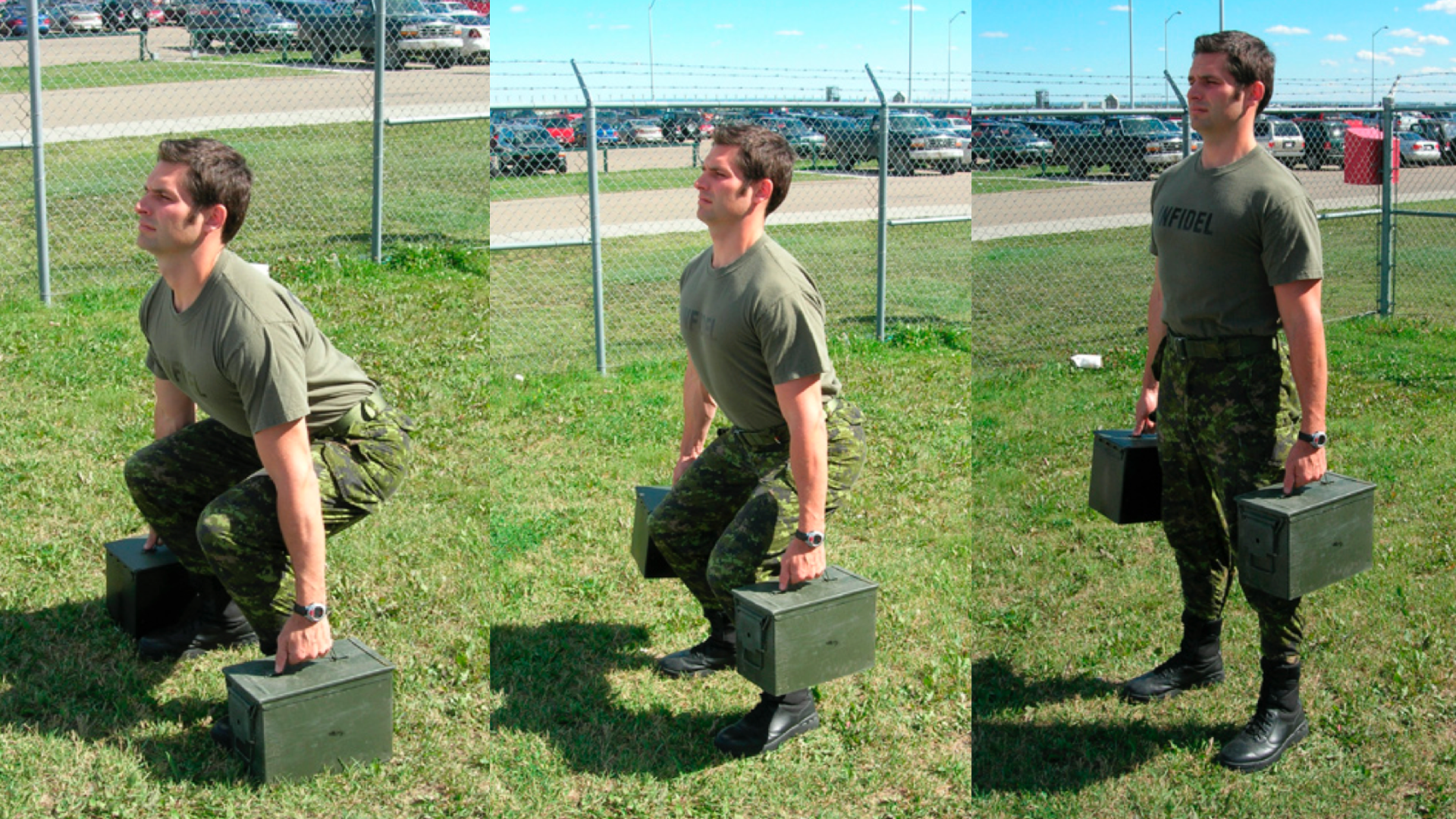
21 deadlifts
15 overhead squats
9 thrusters.
3. EXECUTION
a. Concept of Operations.
- Intent. Complete the exercises in order, as quickly as possible, in a safe manner. This is a four-person-team, “time-specific” workout. The purpose of this workout is to develop cohesion and combat fitness under fatigue conditions through shared hardship, challenges, and competition.
- Scheme of Maneuver. The platoon will be divided into as many teams of four as possible. Each team will require two .50-cal ammo cans for deadlifts, four 6-foot pickets for overhead squats, and one 25-mm ammo can for thrusters. All teams will start at the same time. Each soldier will complete as many rounds of the prescribed exercises as he can in 20 minutes. One soldier from each team begins with the deadlifts; after completing 21 reps, he moves on to the overhead squats, and the next team member begins deadlifts. Ultimately, all team members will be working their way through the rounds at the same time but at their own pace. The soldiers will complete the exercises in order; they must finish the deadlifts before starting the overhead squats and then finish the overhead squats before starting the thrusters. However, they can break up the sets if needed to complete the exercise—for example, the nine thrusters may be completed in three sets of three. Also, solders may take a break at any time during the workout. During these breaks, another team member who is on the same exercise can “work in” and conduct his reps of the exercise. This will allow for maximum use of equipment and time. Spotting will not be permitted at any time during the workout.
- Main Effort. The safety of all personnel, and the development of unit cohesion and combat fitness through shared challenge and hardship.
- End State. The safe and successful completion of all exercises.
b. Coordinating Instructions.
- Team Organization. Squad leaders can organize their soldiers however they wish. It is a leadership decision on how best to deploy each soldier to accomplish the mission.
- Scaling. The workout can be conducted in PT gear or full battle gear to include vests with plates, depending on the fitness levels of your soldiers. Also, soldiers can rest at any time during the workout, if required; however, the clock does not stop.
- Scoring. One point is given for each round completed; for example, if a soldier completes 10 rounds and 21 deadlifts plus 15 overhead squats but only 6 thrusters, his score would be 10. The scores of each soldier on the team are combined to obtain the team’s total score. The team that has the highest combined score comes in first. Also, each individual soldier’s score can be ranked in the platoon.
- Safety. Ensure that all equipment is checked and serviceable before conducting the workout, and that all soldiers are proficient in the required exercises. Safety is every member’s responsibility.
4. SERVICE SUPPORT
a. Equipment Weights
| Ammo Can Nomenclature | Quantity/Size | Type | Weight | Contents |
|---|---|---|---|---|
| Cart 25 mm APFSDS-T | 30 rds | PA125 | 70 lbs | Sand |
| Cart cal .50 4B/1T | 100 rds | M2A1 | 50 lbs | Sand |
| Picket | 6 feet | 5410-990139-4444 | 10 lbs | NA |
b. Equipment Requirements. Each four-person team will require two .50-cal ammo cans, four 6-foot pickets (taped or zap strapped together, Ref Ann B) and a 25-mm ammo can.
c. Time and Repetition Recording. One stopwatch for all teams and a method of recording each soldier’s reps.
5. COMMAND AND SIGNAL
a. Timer/Score Recorder. Only one timekeeper is required for all teams. All four-person teams begin the workout at the same time. It is recommended that at least one participant also start his stopwatch to act as a backup in case the primary timekeeper’s stopwatch fails.
b. Instructor/Coach. To ensure proper conduct of the workout, use of correct exercise form, and safety of execution, a designated member of the platoon can fill this billet.
Annexes
Annex A – Workout Diagram

Annex B – Equipment


Annex C – Exercises


thruster


deadlift


overhead squat
This article, by BSI’s co-founder, was originally published in The CrossFit Journal. While Greg Glassman no longer owns CrossFit Inc., his writings and ideas revolutionized the world of fitness, and are reproduced here.
Coach Glassman named his training methodology ‘CrossFit,’ which became a trademarked term owned by CrossFit Inc. In order to preserve his writings in their original form, references to ‘CrossFit’ remain in this article.

Greg Glassman founded CrossFit, a fitness revolution. Under Glassman’s leadership there were around 4 million CrossFitters, 300,000 CrossFit coaches and 15,000 physical locations, known as affiliates, where his prescribed methodology: constantly varied functional movements executed at high intensity, were practiced daily. CrossFit became known as the solution to the world’s greatest problem, chronic illness.
In 2002, he became the first person in exercise physiology to apply a scientific definition to the word fitness. As the son of an aerospace engineer, Glassman learned the principles of science at a young age. Through observations, experimentation, testing, and retesting, Glassman created a program that brought unprecedented results to his clients. He shared his methodology with the world through The CrossFit Journal and in-person seminars. Harvard Business School proclaimed that CrossFit was the world’s fastest growing business.
The business, which challenged conventional business models and financially upset the health and wellness industry, brought plenty of negative attention to Glassman and CrossFit. The company’s low carbohydrate nutrition prescription threatened the sugar industry and led to a series of lawsuits after a peer-reviewed journal falsified data claiming Glassman’s methodology caused injuries. A federal judge called it the biggest case of scientific misconduct and fraud she’d seen in all her years on the bench. After this experience Glassman developed a deep interest in the corruption of modern science for private interests. He launched CrossFit Health which mobilized 20,000 doctors who knew from their experiences with CrossFit that Glassman’s methodology prevented and cured chronic diseases. Glassman networked the doctors, exposed them to researchers in a variety of fields and encouraged them to work together and further support efforts to expose the problems in medicine and work together on preventative measures.
In 2020, Greg sold CrossFit and focused his attention on the broader issues in modern science. He’d learned from his experience in fitness that areas of study without definitions, without ways of measuring and replicating results are ripe for corruption and manipulation.
The Broken Science Initiative, aims to expose and equip anyone interested with the tools to protect themself from the ills of modern medicine and broken science at-large.

Support the Broken Science Initiative.
Subscribe today →
recent posts
If you're seeing this page, you are not currently logged into a profile with access to Affiliate Owners / Medical.
At the 2026 Unbreakable Health Retreat in Miami, Emily Kaplan hosted a panel with Bob Kaplan, Professor Thomas Seyfried, and Dr. Derek Lee on what it means to treat cancer as a metabolic disease. They discussed the glucose-ketone index (GKI), nutritional ketosis, and strategies aimed at restricting the fuels cancer cells depend on while considering how metabolic therapy can fit alongside standard cancer treatment.
The conversation also addressed the practical realities patients face when trying to pursue a metabolic approach within the conventional oncology system, including questions about nutrition, repurposed drugs, inherited cancer risk, and how to evaluate different treatment options. Seyfried and Lee connected these clinical questions back to mitochondrial dysfunction, fermentation, and the metabolic vulnerabilities that may offer additional targets for cancer treatment.
An abbreviated version of this discussion is available here, for free.
At the 2026 Unbreakable Health Retreat in Miami, Professor Thomas Seyfried presented the case that cancer is fundamentally a mitochondrial metabolic disease rather than primarily a genetic one. He contrasts the dominant somatic mutation theory with a metabolic model in which impaired mitochondrial respiration drives a shift toward fermentation, dysregulated cell growth, and the mutations commonly associated with cancer.
Citing the work of Otto Warburg and research from his lab at Boston College, Seyfried explains how cancer cells rely heavily on fermentable fuels—particularly glucose and glutamine—and why mitochondrial dysfunction sits upstream of many of the genetic abnormalities seen in tumors. He also discusses reactive oxygen species, altered cellular signaling, and the role of mitochondria in regulating cell growth and behavior.
The presentation then turns to the therapeutic implications of this model. Seyfried explains strategies aimed at placing tumor cells under metabolic stress by restricting the fuels they depend on, including ketogenic metabolic therapy and approaches targeting glucose and glutamine. For Seyfried, the therapeutic target follows directly from the biology: restrict the fuels cancer cells depend on, exploit their metabolic weaknesses, and treat mitochondrial dysfunction as the central feature of the disease.
An abbreviated version of this discussion is available here, for free.
MetFix and BSI Members can view the full 54-minute video.


